Describe
A trusted source publishes what a resource means, who owns it and which version is current.
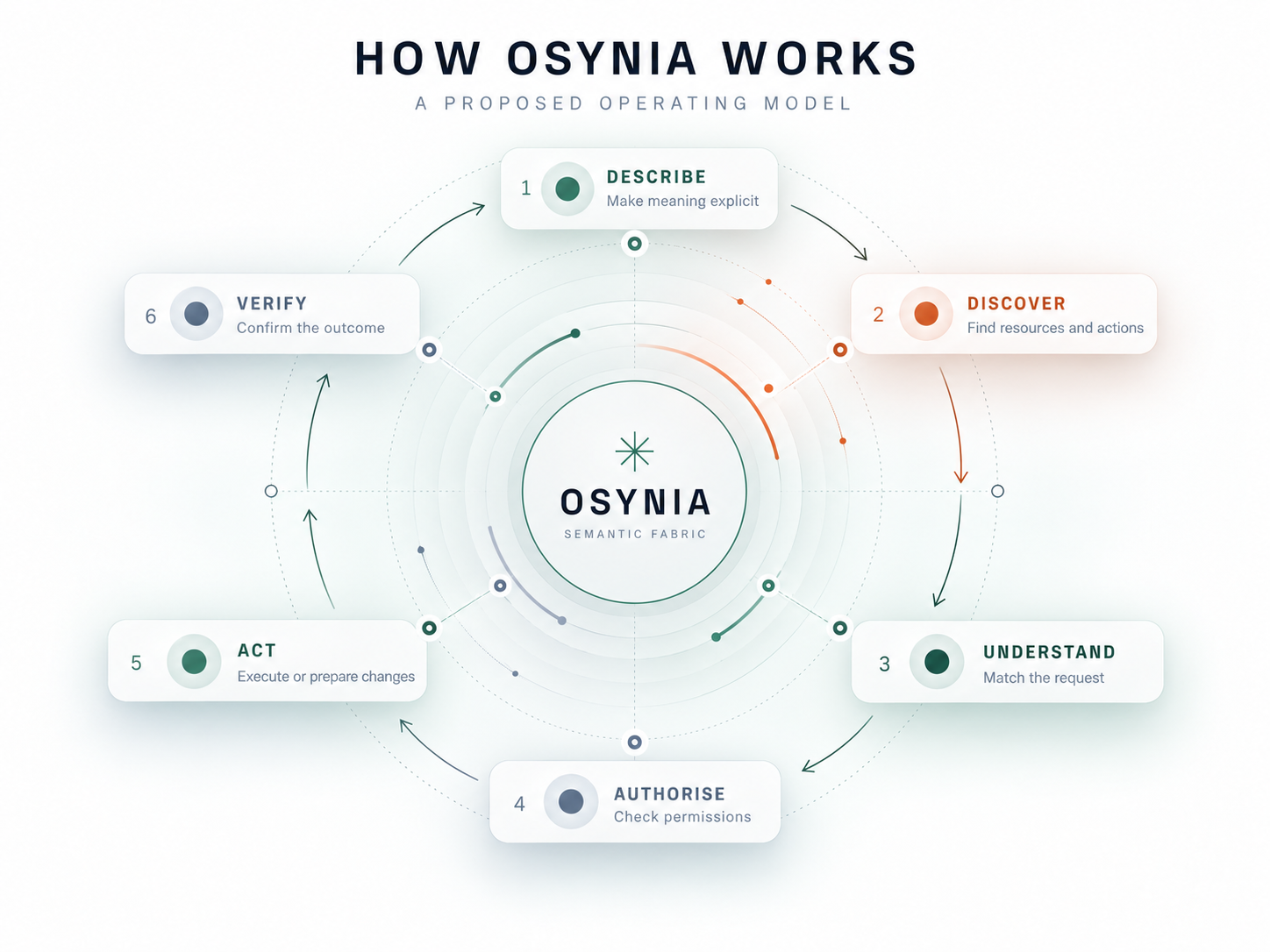
OSYNIA explores a reusable way for systems to describe what they know, expose what they can do and deliver verifiable results. The same foundation could support many business use cases.
This six-step model is a conceptual design, not a deployed end-to-end protocol.
Choose General or Technical in the top navigation to see how the explanation changes.
A trusted source publishes what a resource means, who owns it and which version is current.
A person or system finds information and supported actions from participating providers.
The request is checked against available information. AI is used when the task genuinely needs reasoning.
Before any consequential action, the responsible provider checks identity, permissions and approval.
A provider executes the approved operation or prepares a reviewed content update.
The person receives a trustworthy result, a source reference or a clear error.
Stable identifiers, assertions, representations, authority and version metadata.
Trusted registries, discovery queries, source evidence and capability matching.
Schema validation, deterministic retrieval and optional small/large-model escalation.
OIDC, policy enforcement, preconditions, consent and transaction boundaries.
Typed inputs, idempotent command execution and version-aware change proposals.
Provider-issued receipts, audit trail, outcome status, version references and failure semantics.
Resource → Discovery → Validation / Reasoning → Policy → Capability → Outcome ReceiptExplore enterprise documentation, videos, business actions, product discovery and accessible delivery. Each use case includes a request, before-and-after comparison, processing steps, sample response, limits and research measures.