Choose a real problem
For example, change one official product fact and locate every related help article and description.
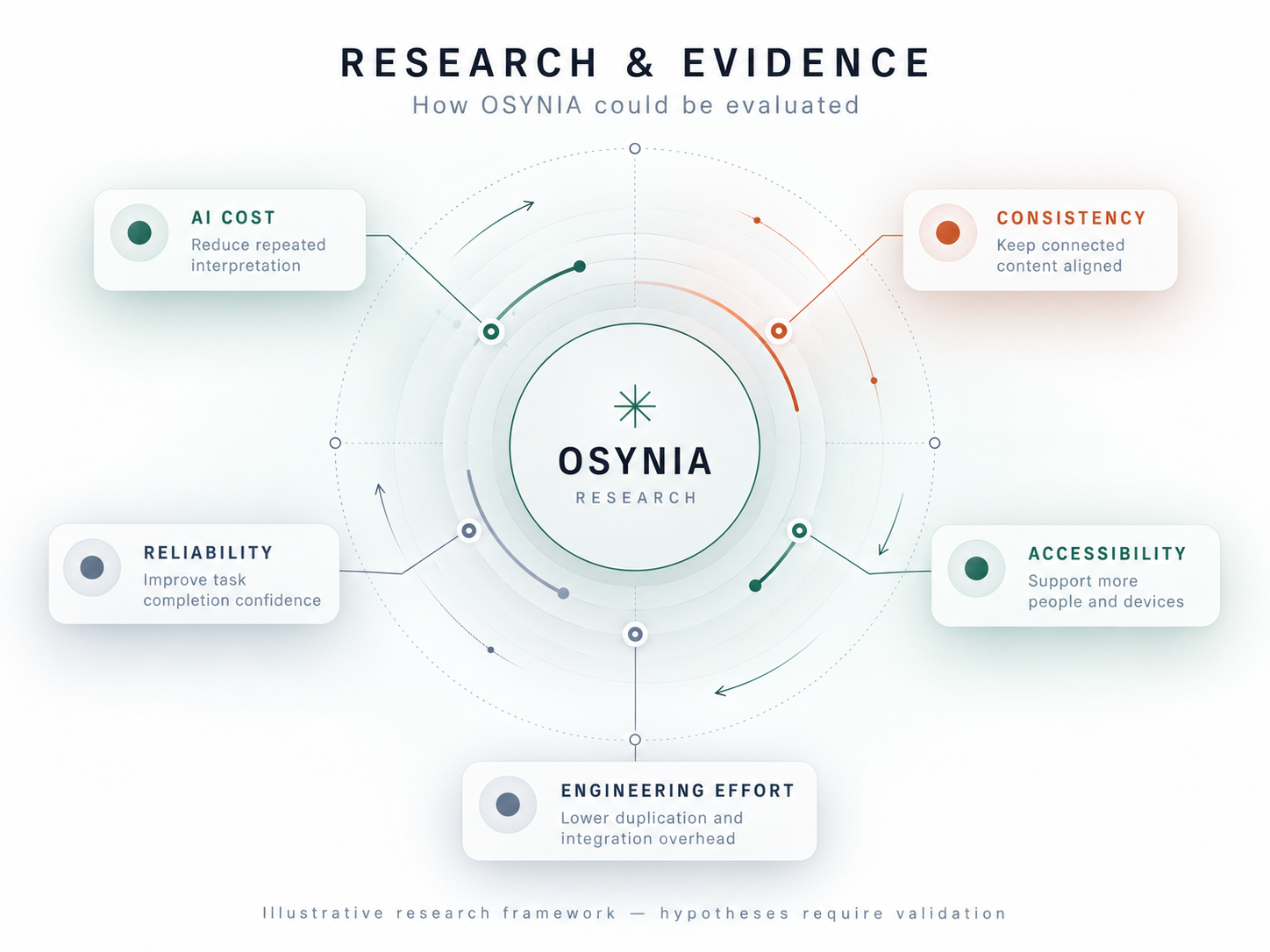
OSYNIA is a proposed approach. Its value must be tested against real alternatives, using reproducible methods and independent review.
Can structured source meaning reduce unnecessary AI processing for repeatable tasks?
Can explicit resource relationships improve the completeness and reliability of content-change reviews?
Can clearly described capabilities make trusted cross-system actions easier to implement?
Compare ordinary web/API approaches, existing relevant standards and proposed OSYNIA contracts under the same tasks. Record correctness, latency, token use, integration effort, accessibility outcomes, failure behaviour and lifecycle cost.
OSYNIA does not claim to replace HTTP, JSON-LD, Schema.org, RDF, OpenAPI, AsyncAPI, OAuth or existing agent interfaces. The research must show what is missing and which parts can be reused.
Current status: proposal and website examples. The scenarios on this website are illustrative. No independent benchmark, conformance suite or multi-vendor adoption claim is being made here.
Publish a narrow resource contract, a working example, a reproducible baseline, and an open feedback process. Improve or reject claims that the evidence does not support.
Contribute a critical review ↗Use the General / Technical switch in the top navigation. Both views cover the same idea at different levels of detail.
A bold idea is not enough. Visitors should be able to see what has been built, what has only been proposed and what evidence would support a claim.
For example, change one official product fact and locate every related help article and description.
Complete the task using established techniques and a proposed OSYNIA implementation.
Show correctness, time, cost, failure cases and the additional work needed to keep descriptions accurate.
Current status: Research proposal and illustrated examples. The site must not present hypothetical success messages as measured results.
Benchmark design: identical source corpus, query distribution, environment, model configuration, caching policy and permitted actions for baseline and OSYNIA variants.
Task correctness, semantic match precision/recall, end-to-end latency, token consumption, compute cost, human correction rate.
Publisher onboarding effort, contract maintenance overhead, stale-content windows, schema evolution complexity, accessibility coverage.
Authority spoofing, permission bypass, replay, version conflicts, failed subscriber updates and unauthorised capability execution.
Release fixtures, scripts, dataset description, assumptions, test environment, uncertainty intervals and independent implementation results where licensing permits. Compare against WebMCP/MCP, JSON-LD/RDF and existing API solutions before proposing new primitives.
We will compare the proposed approach with well-designed existing websites and services — not an artificially weak alternative.
Total processing and AI cost for each correctly completed task.
Time and mistakes when changing information referenced in many places.
How often tasks succeed safely and without human intervention.
Task completion on slow connections, screen readers and without an AI model.
Engineering hours needed to build and maintain equivalent functionality.
No percentage improvement has yet been independently demonstrated.
Compare best-practice baseline implementations and OSYNIA prototypes using identical tasks and infrastructure boundaries. Report accuracy and evidence grounding together with token usage, end-to-end cost, latency, change-update error rates, human interventions, security failures, accessibility completion and development effort.
Potential reductions such as 50–90% lower inference cost or 5–20× less manual reference-update work are exploratory targets from the research proposal, not measured outcomes or promises.
Publish methodology, datasets, limitations and reproducible findings. Expand scope only with defensible gains in correctness, interoperability and end-to-end economics.